

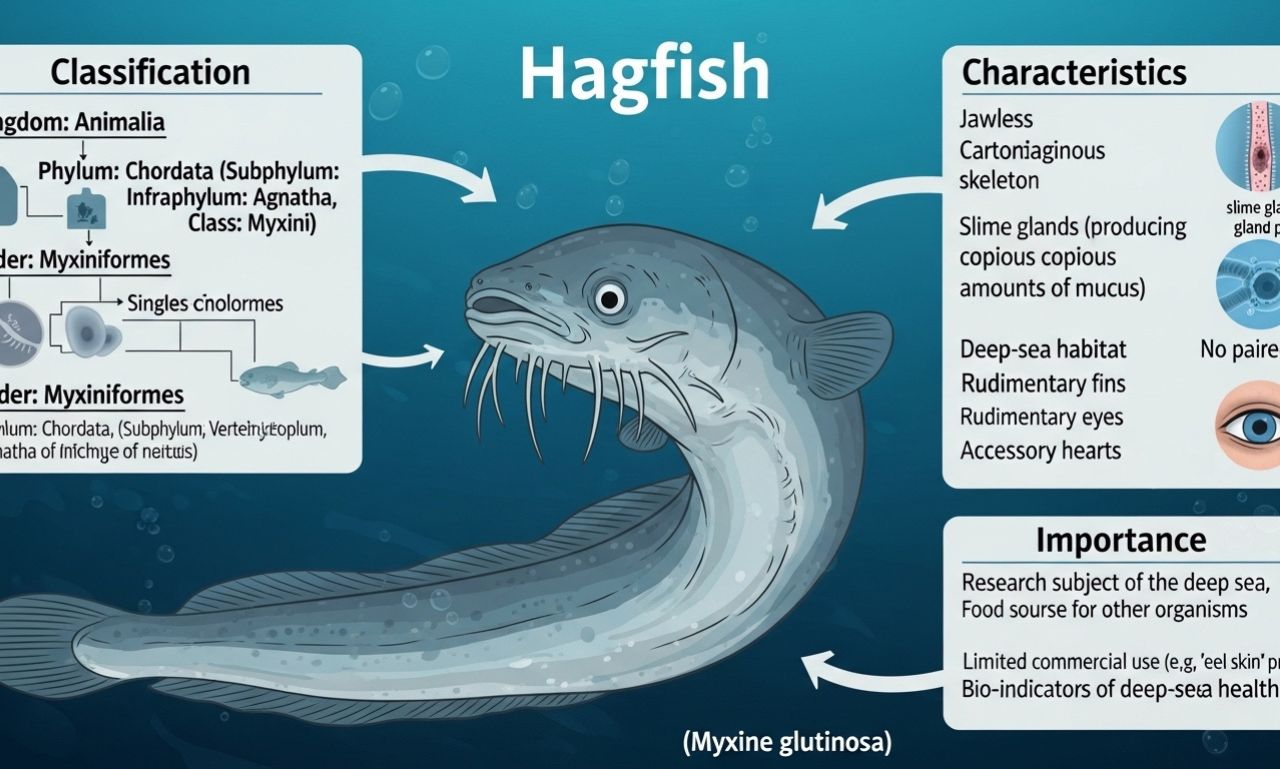
The hagfish phylum refers to the biological classification of hagfish, primitive marine animals known for their eel-like bodies and unique defense mechanisms. Hagfish are of significant scientific interest due to their evolutionary position, providing insights into the early development of vertebrates.
Classification of Hagfish
Hagfish belong to the phylum Chordata, which includes all animals with a notochord, a dorsal nerve cord, and pharyngeal slits at some stage of development. More specifically, they are classified as follows:
- Kingdom: Animalia
- Phylum: Chordata
- Class: Myxini (sometimes referred to as Hyperotreti)
- Order: Myxiniformes
- Family: Myxinidae
- Genus & Species: Multiple species, such as Myxine glutinosa
Hagfish are jawless fish, known scientifically as agnathans, and are considered among the most primitive vertebrates alive today.
Key Characteristics of Hagfish
- Eel-like Body
- Soft, elongated, and flexible bodies
- No vertebral column; instead, a notochord supports the body
- Jawless Mouth
- Hagfish lack jaws and true teeth
- They use keratinous tooth-like structures to scrape food
- Slime Production
- Hagfish secrete large amounts of slime when threatened
- The slime clogs the gills of predators, providing an effective defense
- Feeding Habits
- Scavengers that feed mainly on dead or dying marine animals
- Capable of burrowing into carcasses to consume internal tissues
- Respiration
- Breathe through gill pouches
- Can absorb oxygen through the skin in addition to gills
Habitat and Distribution
Hagfish are marine animals found in cold and temperate oceans worldwide. They generally live at depths ranging from 100 to 1,500 meters and prefer muddy or soft ocean floors, where they can burrow and scavenge.
Importance of Hagfish Phylum
- Evolutionary Significance
- Hagfish are considered living fossils, providing insight into early vertebrate evolution
- They help scientists study the development of vertebral columns and other chordate features
- Economic Use
- Hagfish skin can be used to produce leather products, particularly in some parts of Asia
- Scientific Research
- Hagfish slime has potential applications in biomaterials, such as biodegradable fibers and medical products
Fun Facts About Hagfish
- They can tie themselves into knots to remove slime or gain leverage while feeding
- Their slime is one of the most unique natural defense mechanisms in the animal kingdom
- Despite lacking vertebrae, they are considered vertebrate relatives because of their notochord
Conclusion on Hagfish Phylum
The hagfish phylum highlights a fascinating group of jawless, eel-like marine animals with primitive characteristics. Their unique biology, ecological role as scavengers, and evolutionary significance make them an important subject of study in marine biology and evolutionary science.