

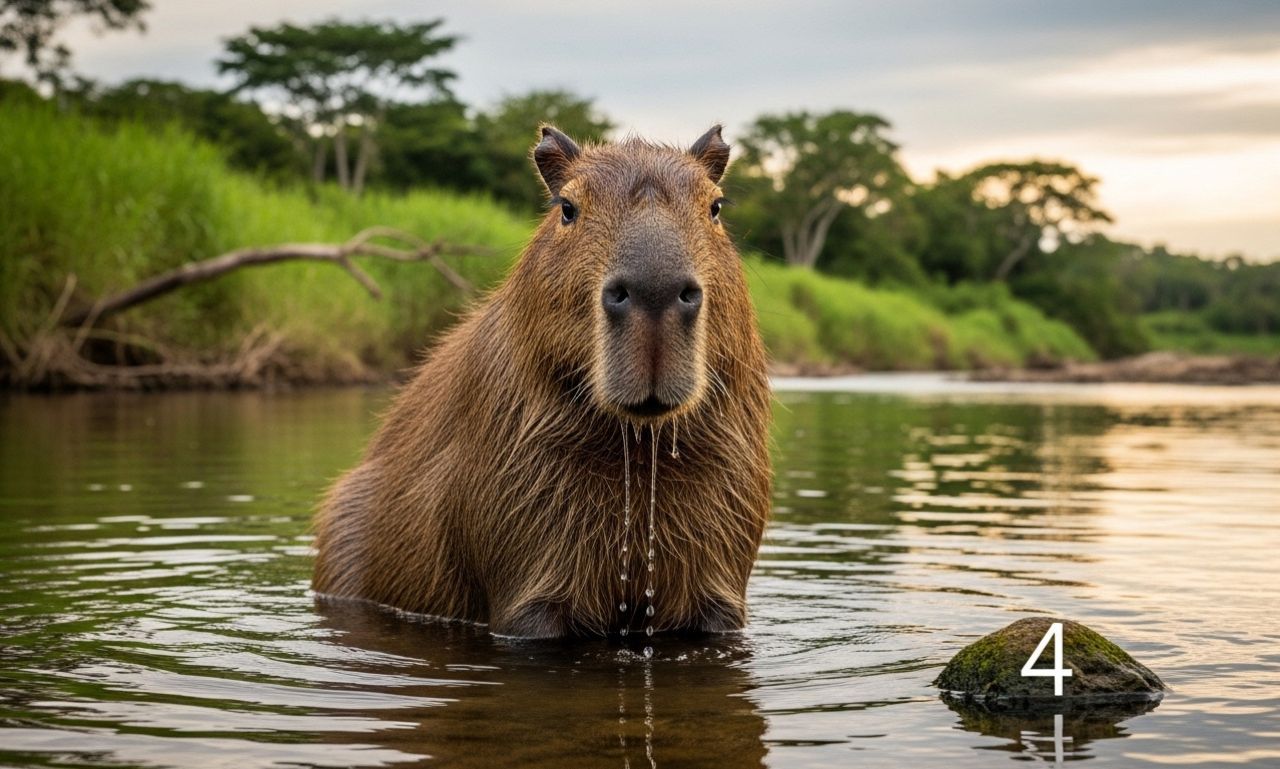
The capybara (Hydrochoerus hydrochaeris) is the largest rodent in the world and one of the most gentle and social animals found in South America. Known for its calm personality and friendly interactions with other animals, the capybara has become extremely popular online and is often called the “chillest animal on Earth.”
Capybaras belong to the same family as guinea pigs and rock cavies, but they are much larger and are perfectly adapted to life near water. These semi-aquatic mammals spend much of their time swimming, grazing, and relaxing in groups along rivers and wetlands.
Physical Characteristics
Capybaras have a unique appearance that makes them easy to recognize.
Key features include:
-
Large, barrel-shaped body
-
Short legs
-
Small ears and eyes
-
Blunt snout
-
Slightly webbed feet for swimming
Size and Weight
Capybaras are surprisingly large for rodents.
-
Length: 1–1.3 meters (3–4 feet)
-
Weight: 35–70 kg (77–154 pounds)
-
Height: about 60 cm (2 feet)
Their thick brown fur helps protect their skin, though it dries quickly after swimming.
Habitat and Distribution
Capybaras are native to South America and are always found near water sources.
They commonly live in:
-
Rivers
-
Lakes
-
Marshes
-
Flooded grasslands
-
Wetlands and forest edges
Countries where capybaras are commonly found include:
-
Brazil
-
Venezuela
-
Colombia
-
Argentina
-
Peru
-
Paraguay
Because they depend heavily on water, capybaras rarely live far from a river or lake.
Diet and Feeding Behavior
Capybaras are herbivores, meaning they eat only plants.
Their diet mainly consists of:
-
Grasses
-
Aquatic plants
-
Fruits
-
Bark and tree leaves
Capybaras are grazers, similar to cows, and can spend many hours each day feeding.
An interesting fact about capybaras is that they practice coprophagy—eating their own feces—to help digest tough plant fibers and absorb more nutrients.
Social Behavior
Capybaras are highly social animals and typically live in groups.
Group Structure of Capybara
A typical group may include:
-
10–20 individuals
-
A dominant male
-
Several females
-
Young capybaras
During the dry season, groups can grow to 40 or more individuals as animals gather around remaining water sources.
Friendly Nature
Capybaras are famous for their calm behavior and tolerance of other animals. In the wild and in zoos, they are often seen resting peacefully alongside:
-
Birds
-
Monkeys
-
Turtles
-
Even predators like crocodiles (in some cases)
Swimming and Water Adaptations
Capybaras are excellent swimmers and can remain underwater for up to five minutes to avoid predators.
Their bodies are adapted for aquatic life:
-
Eyes, ears, and nostrils are positioned on top of the head
-
Slightly webbed feet help them paddle
-
They can sleep partially submerged in water
Water also helps capybaras stay cool in hot climates.
Reproduction and Life Cycle
Capybaras reproduce relatively quickly compared to many mammals.
Reproductive facts:
-
Gestation period: about 150 days
-
Litter size: 2–8 babies (pups)
-
Babies can walk and swim shortly after birth
Young capybaras stay with the group and are often cared for by multiple females in the herd.
Capybaras typically live 8–10 years in the wild, though they may live longer in captivity.
Predators and Threats of Capybara
Despite their size, capybaras face several natural predators.
Common predators include:
-
Jaguars
-
Pumas
-
Anacondas
-
Caimans
-
Eagles (for young capybaras)
Their best defense is staying close to water, where they can quickly escape by diving.
Conservation Status of Capybara
Capybaras are currently listed as Least Concern by conservation groups because their populations remain stable across much of South America.
However, they still face some threats:
-
Habitat destruction
-
Hunting for meat and leather
-
Agricultural expansion
In many regions, capybaras have adapted well to living near humans.
Why Capybaras Are So Popular
In recent years, capybaras have become internet Capybara celebrities because of their relaxed and friendly behavior.
People admire them for:
-
Their calm personality
-
Their ability to get along with many species
-
Their adorable appearance
Images of capybaras relaxing in hot springs with monkeys, ducks, and cats have made them viral stars on social media.
Conclusion on Capybara
The capybara is a remarkable animal known for its large size, social lifestyle, and peaceful nature. As the world’s largest rodent, it plays an important role in South American ecosystems while also capturing the hearts of animal lovers around the globe. With their strong swimming abilities and friendly temperament, capybaras remain one of the most fascinating mammals in the animal kingdom.